
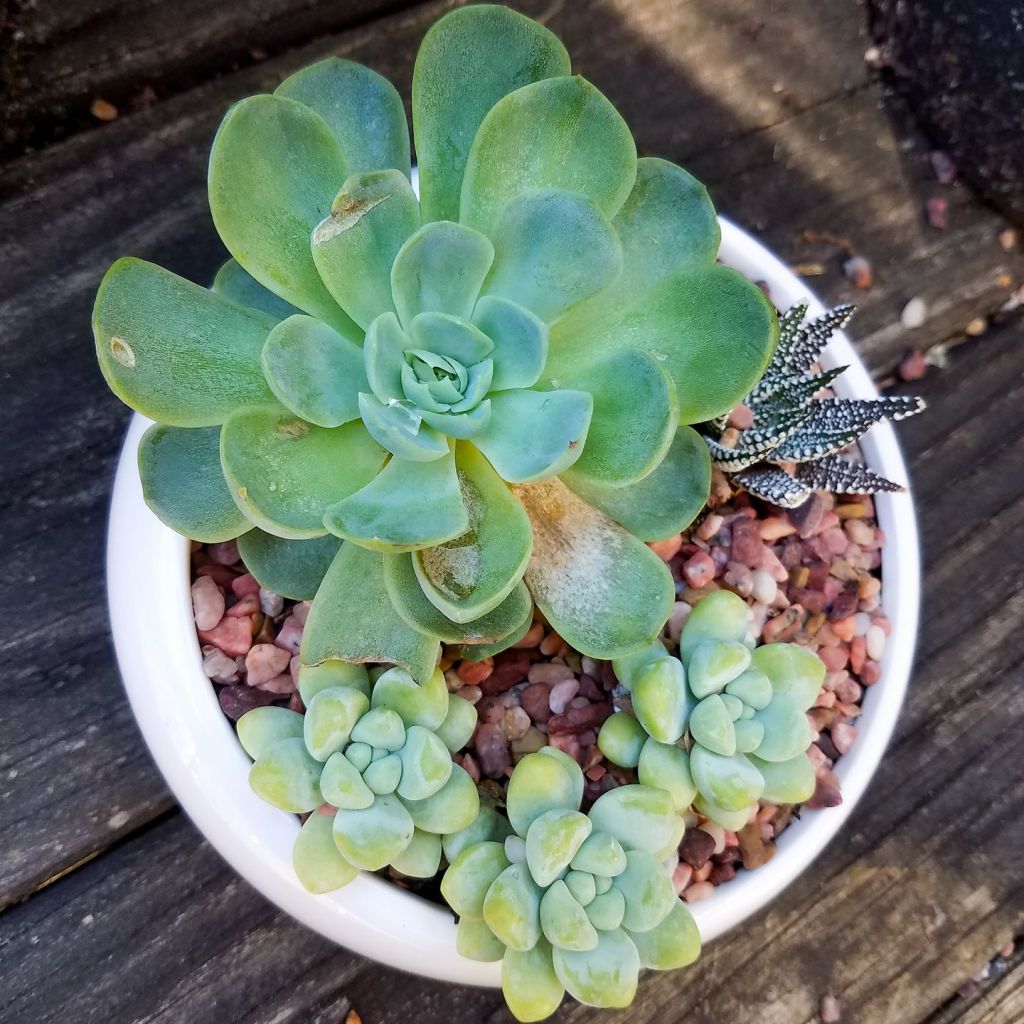
Succulents are those adorable, trendy little plants with the chubby leaves. They come in lots of different shapes and varieties, and they got really popular around 2015 or so. Besides being on-trend and catering to a particular minimalist aesthetic, succulents rose to popularity when they earned a reputation for being “easy” and “low-maintenance” houseplants since they don’t need to be watered very often.
I got my first succulents (pictured above) in the summer of 2017 so I could see what all the hype was about. Since then I’ve both nurtured and killed my fair share of succulents, so I do feel qualified to weigh in on the topic of succulent care. I’m here to set the record straight about what make succulents easy, what makes them actually a little tricky to care for, and things people tend to get wrong about succulents.
Are succulents easy?
While succulents are low-maintenance under the right conditions, and are tolerant of infrequent waterings (and even a little neglect,) I wouldn’t say they are the most resilient of plants. When I think of an easy plant, I think of one that can bounce back easily from improper care and survive (and maybe even thrive) under less-than-ideal conditions.
Succulents are not that plant. They’re particular about their needs, and if those needs aren’t met properly, succulents go downhill pretty fast. They need lots of light, and they like to be watered thoroughly and then dry out for a while. If a succulent gets too much water, it’s probably a goner. If it doesn’t get enough light, it’s going to lose its cute, compact shape and healthy color.
So, are succulents easy? They are if you know what they need! Succulent care isn’t complicated, but you do have to get it right.
How to care for succulents
Succulents are desert plants. They grow in rocky soil in areas where it’s hot, dry, and sunny, and they store water in their puffy leaves so they can survive between infrequent rain showers. Recreating these conditions is the best way to make your succulents happy.
Light
I find the biggest challenge in caring for succulents is making sure they get enough light. When succulents don’t get enough light, they “stretch” towards the nearest light source. You can tell a succulent is “stretched,” (or etiolated, to use the fancy term,) when the leaves get smaller and farther apart. They also tend to look pale and just generally unhealthy. This is why you can’t stick a succulent in your windowless office cubicle and expect it to stay cute, compact, and alive.
This isn’t so much of a challenge in the warmer months, when they can just sit outside all the time. In the summer I just set them on the patio where the sun hits in the afternoon and they love it. In the winter, though, I have to bring them inside and stick them under a grow lamp.
Water
Succulents like to be watered thoroughly, then dry out quickly and stay dry for a bit before they’re watered again. That’s it! Add water until it starts to drain out the bottom of the planter, then leave it alone until the soil is completely dry. When in doubt, wait another day (or two) before watering again. Succulents are much more tolerant of too little water than they are of staying too damp.
One misconception I’ve seen is that succulents should either be misted, or given small, frequent waterings. Succulents don’t need to be misted. They’re from the desert, so they’re not looking for humidity. And while smaller, more frequent waterings seems like a way to avoid giving succulents too much water, it can actually have the opposite effect of keeping the soil just slightly damp all the time, which can lead to root rot and an untimely demise.
Soil & Planting
The soil you put your succulent in also makes a difference here. The basic houseplant potting soil you can buy is too organic and holds too much water for succulents. Even the special “succulent mix” potting soils are too organic. Adding rocks or perlite is a good way to break up the soil and allow water to drain out more quickly. I use the succulent soil and some small river rocks or gravel to make my own 50/50 mixture of rocks and soil. It’s worked well for my succulents!
Planters with drainage holes are ideal to make sure any excess water has somewhere to go so your plant’s roots aren’t just rotting in a puddle. Terra cotta planters are great because they’re so breathable. I’ve had good luck with ceramic planters, too, as long as they have good drainage and I make sure to let the soil dry out for a while between waterings.
Should you get a succulent?
If you can figure out how to get your plants access to a strong light source, then yes, probably. As long as they get enough light and you don’t water them too often, succulents are pretty happy to do their own thing without a ton of maintenance. They’re cute, they come in lots of different varieties, and they’re fun to propagate!

 The Eberblog
Leave a reply to My Orchid Re-Bloomed, and Yours Can Too! – The Eberblog Cancel reply